What motivates people to share content on social media?

Social media marketing is a powerful way for brands to get their message in front of customers on a regular basis. It’s also a great way to generate leads and increase sales. But, if you want your content to be seen and shared on social media, it needs to be interesting and valuable.

We’ve all seen social media posts that suddenly went viral and were shared with millions of people across the internet. Some of them were even created by companies or brands, including these:

https://platform.twitter.com/embed/Tweet.html?creatorScreenName=smonnes&dnt=false&embedId=twitter-widget-0&features=eyJ0ZndfdGltZWxpbmVfbGlzdCI6eyJidWNrZXQiOltdLCJ2ZXJzaW9uIjpudWxsfSwidGZ3X2ZvbGxvd2VyX2NvdW50X3N1bnNldCI6eyJidWNrZXQiOnRydWUsInZlcnNpb24iOm51bGx9LCJ0ZndfdHdlZXRfZWRpdF9iYWNrZW5kIjp7ImJ1Y2tldCI6Im9uIiwidmVyc2lvbiI6bnVsbH0sInRmd19yZWZzcmNfc2Vzc2lvbiI6eyJidWNrZXQiOiJvbiIsInZlcnNpb24iOm51bGx9LCJ0ZndfZm9zbnJfc29mdF9pbnRlcnZlbnRpb25zX2VuYWJsZWQiOnsiYnVja2V0Ijoib24iLCJ2ZXJzaW9uIjpudWxsfSwidGZ3X21peGVkX21lZGlhXzE1ODk3Ijp7ImJ1Y2tldCI6InRyZWF0bWVudCIsInZlcnNpb24iOm51bGx9LCJ0ZndfZXhwZXJpbWVudHNfY29va2llX2V4cGlyYXRpb24iOnsiYnVja2V0IjoxMjA5NjAwLCJ2ZXJzaW9uIjpudWxsfSwidGZ3X3Nob3dfYmlyZHdhdGNoX3Bpdm90c19lbmFibGVkIjp7ImJ1Y2tldCI6Im9uIiwidmVyc2lvbiI6bnVsbH0sInRmd19kdXBsaWNhdGVfc2NyaWJlc190b19zZXR0aW5ncyI6eyJidWNrZXQiOiJvbiIsInZlcnNpb24iOm51bGx9LCJ0ZndfdXNlX3Byb2ZpbGVfaW1hZ2Vfc2hhcGVfZW5hYmxlZCI6eyJidWNrZXQiOiJvbiIsInZlcnNpb24iOm51bGx9LCJ0ZndfdmlkZW9faGxzX2R5bmFtaWNfbWFuaWZlc3RzXzE1MDgyIjp7ImJ1Y2tldCI6InRydWVfYml0cmF0ZSIsInZlcnNpb24iOm51bGx9LCJ0ZndfbGVnYWN5X3RpbWVsaW5lX3N1bnNldCI6eyJidWNrZXQiOnRydWUsInZlcnNpb24iOm51bGx9LCJ0ZndfdHdlZXRfZWRpdF9mcm9udGVuZCI6eyJidWNrZXQiOiJvbiIsInZlcnNpb24iOm51bGx9fQ%3D%3D&frame=false&hideCard=false&hideThread=false&id=996829304054009856&lang=en&origin=https%3A%2F%2Fwww.upthereeverywhere.com%2Fblog%2Fmotivates-people-share-content-social-media&sessionId=32865da68abb29cae39445e173c171457911aedb&siteScreenName=UP_For_It&theme=light&widgetsVersion=2615f7e52b7e0%3A1702314776716&width=550px

The National Geographic #PlanetOrPlastic campaign is one good example of engaging brand content that went viral.

Beyond these viral campaigns, what makes content likely to be shared by your target audience? How can you create content they think is worth engaging with or sharing?

If you’re like many marketers, creating engagement is one of your top challenges with your social media content. 

Get a social media planning template

Common reasons people share content on social media

The motivation behind sharing content on social media platforms varies from person to person. If you want to create successful social media marketing campaigns, it helps to understand why people share different types of content.

Some common motivations people have for sharing on social media platforms include:

1. To be helpful and share knowledge

Some people share content to inform, amuse and help others. For 94% of us, that’s the main reason for sharing on social media, according to a New York Times survey.

2. To define who they are

Letting others know who they are and what they care about is a motivation for at least 68% of people who share content online. For many people, using social media is a way to create a personal brand or express opinions.

3. To stay close to friends and family

People also share content on social media to keep in touch with others and build stronger connections. The NYT’s research uncovered that a big motivation for people who share content online is to connect with other people with similar interests and to stay in touch with old friends.

4. To feel more fulfilled

People share content because it makes them feel more involved in the world around them. Sharing content is one way to feel as if you are making a difference or involved in your community.

5. To support favorite causes or brands

People express their support for causes and ideas they believe in by sharing content online.

What types of content get shared?

Videos are six times more likely to be retweeted than posts with images, and three times more likely to be retweeted than gifs.  Tweets with images get shared 150% more often than those that are only text.

Different types of posts stimulate likes, shares, and comments on social media. The type of post that gets the most engagement on social media is typically one that is both personal and relatable.

  • Personal stories that are not too long (or too short) tend to get a lot of engagement. How can you adapt stories to your brand’s own content strategy? Consider telling background stories, customer success stories, or founder stories that provide context your audience can relate to.
  • Humor and memes, of course, rank among the types of content that get the most engagement, including shares. But creating humorous content that strikes the right balance between wit and entertainment without crossing a line can be a tricky endeavor. Still, when it’s done well, it often “wins the internet.”
  • Articles. One of the most popular types of content that gets engagement and shares on social media is articles. This can include blogs, news, and “round-up” or opinion posts. Everything from how-to posts to top-10 lists help you generate traffic and gather eyeballs for your content.
  • Videos are increasingly the most popular type of content on social media. From Facebook/Instagram Reels to YouTube or TikTok videos, this is a format you can’t ignore. Be sure to keep in mind the specific file size, aspect ratio, and length limits on various platforms. For example, native Twitter (uploaded) videos are limited to 2 minutes and 20 seconds and support aspect ratios between 1:1 and 2:1 (but a square format performs best).
  • Infographics are another type of content that is frequently shared on social media. These data-rich visualizations of interesting facts, figures and key points are a compelling way to educate, inform and build brand awareness.
  • Interactive content, such as quizzes, polls or games, is still among the type of content most frequently shared on social media.
share_this_graphic-1

Top reasons for sharing

An Ipsos study revealed several interesting takeaways about why people share:

  • 61% of people worldwide will share “interesting things”.
  • 43% of people will share things that they feel are “important” or “funny”.
  • 30% of global users indicated they shared content to recommend a product, service or movie.
  • 29% shared something “to support a cause, an organization or a belief”.
  • 26% will share “unique things”.
  • 22% want “to let others know what I’m doing”.

Sharing differences by country

The same study showed that while the top reason for sharing content in nearly all countries surveyed was “important things,” it wasn’t the case in Saudi Arabia. There, the top reason (65%) reported for sharing something on social media was to let “others know what I believe in and who I really am.” 

That answer also ranked highly in Brazil, where 60% agreed. Comparatively, only 37% of the rest of the world said this was their top reason for sharing.

The survey also showed some regional differences in the willingness to share “interesting” content. That reason topped the list in China, Indonesia, South Africa and Turkey, whereas it was at the bottom of the list in Japan, Germany and Saudi Arabia.

In Sweden, people are most likely to share “interesting” things and least likely to share “to show I’m in the know.” That might not surprise anyone who knows Swedes don’t like to brag (even if they are the Capital of Scandinavia). Turkey is the most likely to share information for that reason (33%).

Create shareable content

If you’re looking for help or inspiration in creating social media content for your brand, reach out to UP for support. Have a question?  Leave a comment below, or feel free to ask me.
New Call-to-action

Originally published on the UP There, Everywhere blog

Top marketing trends 2022

The top 10 digital marketing trends of 2022

The last few years have been unparalleled in many different ways, and 2022 will likely continue the trend. But are the recent developments we’ve seen emerging globally likely to stick around, or were the last two years anomalies?

Well, no one can say for certain, but in all likelihood some digital marketing trends are poised to fade away, while newer ones emerge. And of course, some of the top digital trends of 2022 have actually been around for a long time, but are taking hold with greater force this year.

Here are the top 10 digital trends of 2022 and what they mean for you.

1. Privacy

It’s becoming more and more difficult for marketers to access data that they’ve been able to gather easily in the past. First came GDPR (the data protection requirements in 2018 that rocked the EU).  Then, consumer demand for more privacy led Google to banish third-party cookies starting this year, a change which has serious implications for digital marketing and advertising.

And most recently, Austria has banned the use of Google Analytics altogether, claiming that encryption-at-rest and other workarounds for data privacy laws are not enough to stay compliant with GDPR.  The Austrian data protection authority (DPA) determined that IP addresses and identifiers in cookie data are sufficiently personal to constitute a GDPR violation. (And that the transfer of data to Google, a US-based company, violates GDPR data access rules). The real question is, is this the start of a trend across Europe?

Third-party cookies are small bits of code that get added to a user’s browser when visiting a website to track page visits and other metrics. Marketing and advertising businesses use cookies to check visitor behavior and target ads.

These challenges to the use of cookies and Google Analytics leave many website owners and marketers scrambling for alternatives to manage effectiveness metrics. Anonymity and permission logging (through opt-in on your own website) are more critical than ever.  

Marketers will be increasingly challenged to use first-party data to guide their campaigns.  Companies who have not been gathering first-party data all along will find themselves scrambling to pull it together to avoid losing their competitive edge come next year.  Google said they will be focusing more on API-based solutions that focus on aggregate rather than individual user data. 2022 could be the year that advertising completely pivots on the web.

Have questions about this? Reach out to the UP for DIGITAL team.

2. Mobile optimization

This trend has been around for a while, but it promises to become even more central to our marketing campaigns in 2022. A recent Pew Research study found the number of people who are online “constantly” has risen 5% from last year. This means that more and more people are living their lives on the Internet via their mobile devices.

Even as the mobile share of website traffic grows exponentially, there are still companies that haven’t managed to keep up. 2022 will be the year that these companies are left behind, at least partly because of the launch of Core Web Vitals from Google.  With this change, Google places more emphasis than ever on creating a good mobile UX (user experience), ramping up the mobile optimization metrics introduced back in 2015.

Loading speed (for mobile) will become of prime importance, which means you won’t be able to rank in the search results without it.  So seize the moment and ensure that your business website is fully optimized to remain competitive in 2022.

Free website evaluation

3. Influencers

At the end of 2021, influencer marketing was headed for the $138 billion mark, and it has only continued its steady growth since then. Influencer campaigns are still powerful, as evidenced by recent successful campaigns from SAP, Adobe, PWC, and others. The success of these marketing efforts also shows that influencer marketing remains surprisingly strong in B2B campaigns.

One important development concerning this trend is the rise of AI influencer marketing. AI can process information far more quickly than human analysts. This highly predictive model of influencer marketing has the potential to boost ROI by only requiring you to pay for sales and conversions.

To stay current with this trend, you’ll need to look for influencers to partner with.

4. Video

It’s now common for mobile devices to come with advanced data plans allowing consumers to stream video wherever they are with ease. All you have to do is look at the exploding popularity of apps like TikTok and Instagram Stories to understand how all-encompassing video has become in our world. It’s everywhere. And savvy marketers will take hold of the video marketing trend this year with enthusiasm.

Streaming services and social media sites will introduce new advertising platforms that make full use of video. Every industry, from retail to healthcare to finance, will innovate in the use of video to engage customers.

Besides being an effective way to reach users on their phones or tablets, videos are just plain fun. Everyone loves them. So if you haven’t found a creative way to implement video marketing, this is the time to do so. (Because you understood the assignment ;-).

The TikTok Video Trend Featuring The Assignment

https://www.tiktok.com/embed/v2/7002756116329368838?lang=en-US&referrer=https%3A%2F%2Fwww.upthereeverywhere.com%2Fblog%2Fthe-top-10-digital-marketing-trends-of-2022

5. Metaverse

Facebook has been around for decades, but the new metaverse represents a huge change in the way this platform will be used for digital marketing. No longer is it just a place for Grandma to look at photos of your vacation. The metaverse will encompass an entire world, affecting every aspect of our lives. (Think: Ready Player One). Virtual reality, augmented reality and holographic avatars will change the way people interact with the Internet.

The possibilities that the metaverse presents to marketers are limitless. It allows them to track how long a user holds a digital object, and even how long viewers spend looking at an ad.

What does it mean for 2022? The visions that companies like Fortnight, Facebook (or rather, now renamed Meta) and Microsoft have for the metaverse may be years in the future, but the interconnected cyberspace of planning multichannel marketing is here now: YouTube, TikTok, Facebook, Instagram all offer specific, targeted interconnected advertising opportunities.

pexels-justin-doherty-4565723-1
Will the future of science discovery be virtual too?

6. Digital skills

In the current job market, digital skills are in great demand, and it doesn’t look like that will change any time soon. The Covid-19 pandemic was instrumental in changing the way we work, ramping up the need for greater digital competence from all stakeholders. The number of job applicants who possess digital skills is sadly low in correlation to the need for these skills.

What does this mean? Smart marketers will constantly work on building their digital skills in order to remain current with industry needs. Company leaders will need to invest in growing the digital skills of their team members to ensure that constant new innovations don’t leave them behind. Certifications like those offered by HubSpot or Google are a good place to start. And you can outsource what you don’t have in-house to experts as the gig economy continues growing as well.

7. Content marketing

Yes, I know what you’re thinking. Content marketing is not a new trend, right? But 2022 will challenge us to think of content marketing in ways we haven’t before. It’s tough to create something compelling in terms of web content today. The Internet is overcrowded with content everywhere you look, so it’s difficult to drown out the noise.

That’s why simplicity and clarity are the order of the day.  Pack a few words with a strong message. Avoid long flowery descriptive passages. Give your content a punch so that it stands out from the crowd. Don’t be afraid to get personal with your audience. It’s equally essential that your writing is clear and easy to understand. If readers have to work to derive meaning from your content, they will go elsewhere.

8.  Voice search

Like most of us, you have probably gotten into the habit of speaking a question out loud to Siri, Alexa or Google, instead of typing the words into a search bar as you have done in the past. The growing popularity of voice search is a serious game changer this year.

When looking for a specific product or service, most consumers are now simply speaking their search as a question. Currently, voice searches make up about 20% of all web searches, and that number continues to grow.

In this new climate, it’s increasingly important for your content to address common spoken questions. Answers to questions like “How do I…” and “What’s the best way to…” will rank higher than content that takes a long time to get to the point. Don’t overlook the value of YouTube (videos) and images (Pinterest and on your website) in relevance for this search content. 

9. Hybrid events

This is yet another legacy from the pandemic. Everyone became comfortable with virtual events: so comfortable, in fact, that many are not ready to give them up just yet.

In response to this, more companies are hosting hybrid events, in which traditional in-person activities are supplemented by an online component. To remain competitive, marketers will need to ensure that any events they host are available digitally, as well as face-to-face.

It’s helpful that new technology in the areas of augmented and virtual reality make it possible for online guests to enjoy an immersive experience similar to what they would have if they were physically present. Event platforms like Hopin and Whova provide interesting and fun interactive functionality for online attendees.  Don’t overlook the value of a well-planned webinar or virtual conference.

Jesper filming webinar-1
Events today can be hybrid with both in-person and online attendees and content optimized for both. Learn more about UP’s webinar and event planning services.

10. Sustainability

Now more than ever, consumers want to support companies with sustainable and eco-friendly business practices. In this context, brand messaging that focuses on your company values (hopefully sustainability ranks high among these), is a key element in successful digital marketing.

If these core values are to truly represent your brand, it’s important that they permeate every level of your business. This gives an image of integrity and authenticity, critical qualities that consumers will be looking for in 2022. How can you convey this image? Consider partnering with a non-profit. Such partnerships have been shown to boost customer engagement, as well as having a powerful impact for a meaningful cause.

To reap the full benefits, make sure that the partnership involves more than just words. Show a real commitment through joint marketing or even through donating a percentage of revenue. And be sure the partnership makes sense – your core values or audiences should be aligned. 

Read more about how UP for GOOD, UP’s CSR and sustainability focused specialty area works with businesses and nonprofits to support common goals.

Get going on trend

These digital marketing trends look like they’re here for a while — for the year 2022, and possibly beyond. Hopping on board with them will go a long way to staying competitive this year and in the future.

Originally published on the UP There, Everywhere blog

Seven tips for social media success in highly regulated industries

For many business in highly regulated environments (such as pharma, medtech, health care and financial sectors), social media may seem like a tool that is either irrelevant or too difficult to manage within stringent and often-changing regulatory parameters. Yet, the truth is, social media is just as applicable to these sectors as other B2B markets, and can be equally as effective. Being compliant and being quiet are not irreversibly fused.

social_media_in_highly_regulated_industries.png

Social media for B2B?

Yes, some of you out there may still think that social media is only for fun and games. Nothing serious is ever accomplished there, and even when serious topics (like politics) are discussed, it’s nothing but avarice and opinions. Right? Well, wrong.

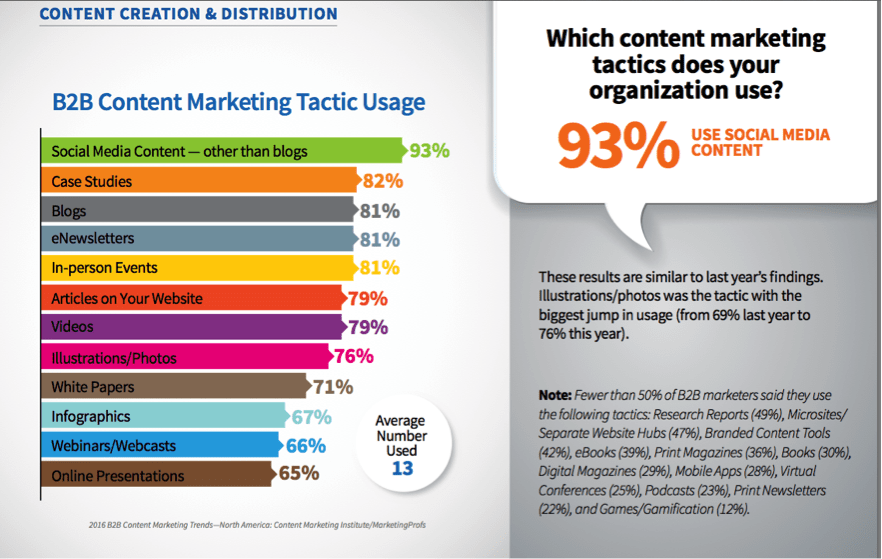
Social media is a very effective tool for many B2B companies not only for promoting their content (more on this here) but also for keeping tabs on the pulse of their markets — what’s known as social listening. In fact, according to a 2016 report from Content Marketing Institute, 93% of B2B marketing organizations use social media. However, according to the same report, only 35% have documented their social media strategy. This could be a major downfall to success (read on for tips below).

Social media content - Content Marketing Institute

(Graphic from Content Marketing Institute Report)

If you’re not monitoring or participating in the conversation, how can you possibly know what your customers, colleagues, partners and prospects are thinking?

This brings me to two important aspects of social media in the B2B world, including regulated industries like healthcare, diagnostics and medical devices. You must focus on both monitoring and engagement.

That translates into LISTENING and SHARING.

Social media monitoring and engagement

Monitoring (listening) in social media means following your customers, partners or networks on Facebook, Twitter, LinkedIn, YouTube and Google+ and other channels, and regularly checking your streams so you are aware of what others in your space are saying. You can use tools such as Hootsuite, HubSpot or Sprout Social to monitor important subject areas and “follow” people you want to stay connected to, setting up alerts for particular areas of interest or “hot topics.”

Engagement (sharing) in social media means contributing to the conversation with new content, thoughts, ideas, reports, images, infographics and other content that your followers and audiences might find useful. It’s not (just) about self-promotion, but also about sharing ideas and contributing to a conversation. Your contributions can be entirely original (such as predictions, posts or reports that you or your company have produced), insights or perspectives on work from others (like adding your comments on news about a new law or protocol) or sharing things you found useful (such as a “How to” article or seminar presentation from the last conference you attended). Apply a simple rule: if your content passes medical, legal and regulatory review processes, it’s a candidate to build an engagement strategy.

How to keep your content compliant

In any business, but especially in the regulated industries, managing your brand’s reputation and keeping your company safe from infractions (perceived or real) requires a few extra steps to ensure success. You’ll want to create a plan that is approved at the highest levels of your organization and followed by everyone in the company who posts on behalf of your brand. Here are some tips for creating a well-organized social media plan:

1. Create a set of guidelines.

The most important first step is to create a document outlining the issues that can and can’t be discussed. If you have proprietary new research or R&D that is classified, all of your team members should be made aware (and firmly reminded) that all such topics are off limits. Be very specific about the words they can and can’t use. However, they may find that the knowledge they have in these areas makes a useful addition to online conversations or in discussions on professional forums. In that case, they should be clearly instructed about what issues are “fair game” for discussion, and where the boundaries are that cross into proprietary, protected or regulated information. Your team should be well briefed in the difference between presenting new facts and helpful information, and any speculation that could appear as an endorsement or recommendation around regulated topics. (Get a sample social media guidelines template here).

2. Develop written talking points.

A simple document or guide that outlines to your team all the most important “themes” or areas of expertise for your company, such as focus areas or new business areas, will give your team the ammunition they need to focus where you want them to focus. You might think everyone knows what to concentrate on, but if you haven’t put pen to paper (or more likely, hands to keyboard), you can’t be sure they are all on the same page.

3. Prepare a content calendar.

Turn your talking points into a social media calendar with posts planned for a week or more at a time. Focus on topics around which your company has expertise and wishes to become known in the market. Include a combination of curated and created content (posts linking back to blog articles or research papers, as well as content you share from other experts, industry conferences or partners). Remember: you want your topics to be about issues, not products. Consider what challenges your target audience is facing and talk to them about things they care about. Mention the problems your products solve, not the brands. The exception would be answering or responding to specific questions that others may post online about your products. (Need inspiration? Download a sample social media planning template here.)

4. Institute an approval process.

In some industries, fly-by-the-seat-of-your-pants witty responses might win points. But in highly regulated industries, off-the-cuff remarks could end up costing you dearly. Make sure that all your content and comments are approved in advance. Create a written approval process (approval template documents help) that everyone on the team understands. Include an approval “check off” at the top of your editorial calendar or blog post templates to indicate who needs to approve it and by when.

5. “Chunk” your content.

One way to ease (and speed) the approval process for new posts is to pull your social media comments and ideas from pre-approved content. Create larger pieces regularly (such as articles, case studies or white papers) with ideas that can be approved all at once. Then, pull bits and pieces of this into social media-worthy posts that let you spread your content out over several weeks.

6. Rework and reuse existing content.

Similarly, you can reuse existing content by turning it into new formats without requiring a lengthy regulatory approval process. Turn a research paper presented at a conference into a series of infographics, Slideshares, or video for YouTube (have the writer or a company thought-leader read it on camera and mix in still graphics or slides with charts). Create Tweetable callout images from the key data that link to a page where people can read the entire report. Turn the presentation into an “interview” with the expert. Think about additional ways to present content that might appeal to your audience.

7. Get help.

If you need additional resources to ensure your content is appealing and also compliant, you might consider looking to outside experts. Look to outsourced resources who have experience writing for regulated industries and know the ins and outs of posting content to social media.

Have any other concerns?

Do you have other concerns about social media we didn’t address here? Ask us in the comments and we’ll be glad to help.

Get a free template for social media guidelines here.

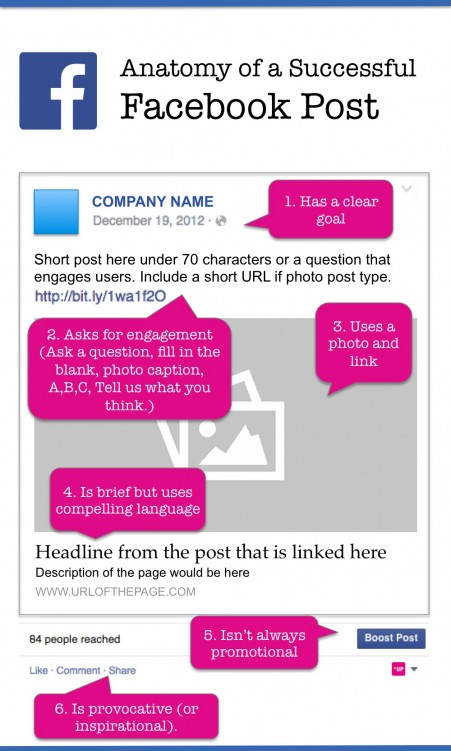
The Anatomy of a Successful Facebook Post

When it comes to using Facebook for business, many people wonder what the secret for success is. What kinds of posts get the best results, and how can you increase engagement? Are there things you should be doing that you’re not?

While there is no one single right way of creating a perfect post, there are some best practices you can follow to help make your posts more successful. We’ve dissected the key elements of successful Facebook posts so you can properly optimize yours.

blog-post-image-captions

But be warned, it’s not all kittens and dancing babies here. You’re going to have to think a little harder about what your business audience needs.

The top six things that make up a truly valuable Facebook post…

1) Has a Clear Goal

The key to a successful Facebook post is to start with a clear objective. What do you want this post to do? Drive traffic to your website? Encourage comments that build community? Get people to share it? Spark a debate? If your post has a specific objective it will be much more effective. And that objective should be obvious.

If you want someone to click on a link and read your blog post, use an enticing headline. If you are introducing a new product, offer a special deal or limited time offer to encourage clicking. Here is an example:

City Brands Group Linked IN

2) Asks for Engagement

A successful Facebook post has a clear call to action. It asks people to follow through in a specific way using words such as “subscribe now,” “share your ideas,” or “tell us what you think.”

Use specific language but be realistic: you can’t expect people to write an essay about how great your product is. Ask them for personal experiences, or opinions on specific situations. Remember, the goal of engagement on Facebook is primarily to build a community and create an interactive outlet of trust and sharing.

Several tried-and-true types of posts to generate engagement on Facebook are:

  • Asking a question. It can be relevant to your product, your audience’s profession or their lifestyle (such as “Blue/black or white/gold?)
  • Fill-in-the-blank statements. Posting a statement asking for a specific response (such as, “The one thing I can’t live without at work is ________.”)
  • Photo caption. Posting a photo (or video) and asking for a funny (or relevant) caption is a great way to get user engagement. (#captionthis #photocaption)
  • A, B, or C options. Posting a statement or photo and asking people which option they agree with. (“If your coworker misses a deadline that affects your delivery, would you rather: A) pick up the slack B) call him out on it C) tell your mom).

Be careful about requesting or requiring people to post something to a friend’s page. Facebook frowns on that sort of activity, which crosses a line to spamming. You may ask people to share something, but never require them to post on another person’s Wall (aka Timeline).

In the example below, the company asks for comments about a new product. The engagement level was high with more than 250 comments and 40 shares.

Example Facebook Post Community Coffee

In this example from Walmart, the company uses the #CaptionThis approach. (OK, I lied — kitten photos get attention.)

Kitten walmart caption this post

3) Includes a Photo and a Link

While photos are typically superior to text-only posts in generating interaction, Facebook reports that link posts outperform photo posts (with links) in generating clicks. Just be sure that when you share a link on Facebook, the page you’re sharing has an image that will appear in the News Feed (a large picture will appear below your post along with a headline and some text when you paste in the URL.)

If not, you might be better off creating a photo post instead with a short link. To do that, click on the photo icon in the status area, and upload a photo. Be sure to add your text and a shortened URL (use a URL shortener such as bitly or owl.ly into the photo description area. Here is an example of a photo post with shortened URL.

Example link post Facebook Tips

URL links in photos (above) may be less effective than linked posts (below) in generating clicks on Facebook. But the photo is very compelling and generated more than 190 shares, as well as over 6,000 likes. The example below is a linked post with a compelling photo.

Example hashtag post facebook tips

4) Is Brief, but Uses Compelling Language

Some studies (such as this one by TrackSocial) have shown that posts with fewer characters (ranging from 40 to 70) get the best results.

Use compelling yet concise language, but avoid “click-bait” phrasing. Click bait refers to using vague or misleading language such as “You’ll never believe the five things this guy said…” to generate clicks, without fulfilling the promise made by the statement. Facebook is working to penalize this practice, and it’s not a good long-term strategy for driving user engagement or lead generation. If people feel misled by your posts, they won’t come back for more.

Example short post facebook tips

5) Isn’t Always Promotional

Be careful not to let your Facebook Page turn into a stream of advertising. Occasional promotions and offers are expected and effective, but you need to balance getting with giving by offering useful content to your audience and being mindful about building a sense of community.

Your posts should be a near 30/70 mixture of promotional content (with links back to your website) and value-added content, in which you share relevant information that your target audience would find useful or interesting or develop the community.

Occasional humor, as long as it’s not offensive and is appropriate for a business audience, is appreciated and can be very effective. You really have to know and understand your audience to make this successful (build your personas!).

The post below from HubSpot is an example of offering valuable educational content to your audience. This post is not promotional, and not even related to HubSpot’s offering, but it has a very high level of sharing among readers (1,000 shares). People appreciate it when you share what you know—without asking anything in return.

Hubspot Excel Blog post

6) Is Provocative (or Inspirational)

Posts that subtly (or not so subtly) tug at your audience’s inner sense of self-worth, or touch on viewpoints with which they can strongly identify, can generate a good response. Be cautious to avoid political, controversial or negative topics (unless that is the underlying goal of your Page). Positive memes and quotes that people can identify with help create a strong connection to your audience for your brand. Make sure the sentiments you post are authentic.

Photos with inspirational thoughts typed into the image (as memes) are a highly effective way of getting shares.

In the example below, Cisco promotes involvement with a women’s tech movement.

Cisco Relevant Post Facebook Tips

The brand-focused meme below from Burt’s Bees is both positive and shareable.

Burt's bees shareable mem

Keep it Real, and Relevant

In conclusion, it’s important that your posts provide an authentic representation of your brand and engage your audience in a way that shows you understand them and their needs. Be clear and direct, use photos and videos, include a call to action, and link back to your website when relevant. It’s the same advice you’ll hear from any good inbound marketer.

So next time you write a Facebook post, follow these 6 guidelines to be as effective as possible.

Need a better way to keep track of your social media posts?

Get a social media planning template here.